金屬頂刊雙語導讀丨Acta Mater. Vol.195(續2)
2020-07-20 來源:Goal Science
本期包含金屬材料領域論文10篇,涵蓋了高溫合金、鈦合金、金屬玻璃、銅合金、鋯合金、鈀合金及鋼鐵等領域,國內科研單位包括香港城市大學、中科院物理所、北京計算科學研究中心等(通訊作者單位)。
Vol. 195 金屬領域目錄
ACTA Vol. 195, 15 Aug. 2020, P555-570
32. A statistical study of the relationship between plastic strain and lattice misorientation on the surface of a deformed Ni-based superalloy
形變鎳基高溫合金表面塑性應變與晶格取向差之間關系的統計性研究
A. Harte?, M. Atkinson, M. Preuss, J. Quinta da Fonseca
A. Harte:allan.harte@ukaea.uk.
https://doi.org/10.1016/j.actamat.2020.05.029
摘要
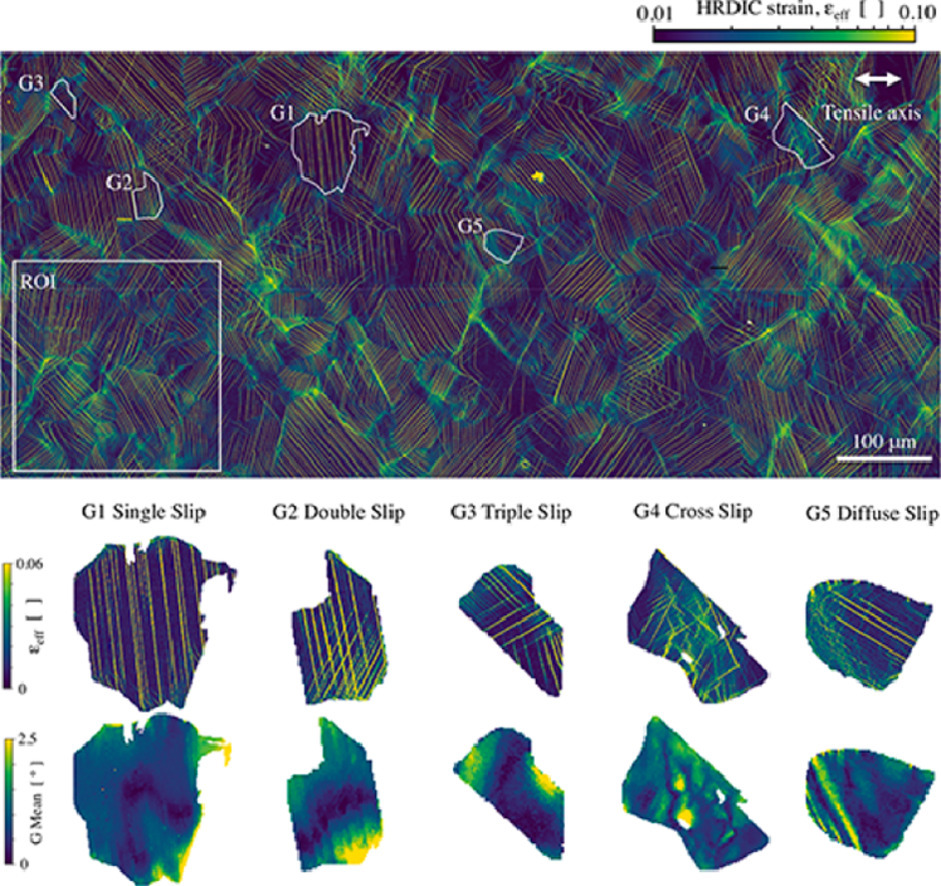
電子背散射衍射(EBSD)是一種識別材料組織中應力集中和量化塑性應變的常用實驗手段。但是,目前我們對于晶粒和亞晶粒之間的取向差隨局部塑性應變的變化規律認識還很不足,需要進一步詳細研究。本工作中,我們使用了高分辨數字化圖像關聯技術(HRDIC)測量了鎳基高溫合金表面亞微米尺度的塑性應變,應變量達到2%。我們在幾百個晶粒中測量了晶粒/亞晶粒取向差和應力大小之間的關系。結果表明,盡管晶粒的平均塑性應變與晶格取向差呈正相關,但在相關關系存在較大的方差,這取決于所取向差的測量方式。晶粒應變的大小和晶粒取向參數(如施密德因子和泰勒因子)之間也沒有本質上的相關性,這主要是由于介觀尺度上的非晶形變帶導致的。在本實驗的應變水平上,取向差和塑性應變之間的關系受滑移和晶格扭轉發展差異的影響,這種差異往往是由于局部晶粒相互作用和跨晶粒應變集中造成的。因此,盡管基于一些潛在的對于局部塑性的理解,測量某些取向差能更有效地反應塑性應變,但僅通過EBSD導出的取向差試圖完全量化單個晶粒內部的塑性應變是不可能的。盡管如此,鑒于滑移帶中的局部滑移導致的取向差僅在空間上隨著滑移逐漸變化,這些發現對于使用連續介質力學在微觀結構尺度上模擬多晶金屬的變形狀態具有重要意義。
英文摘要
Misorientation data from Electron Backscatter Diffraction (EBSD) is often used to identify strain localisation and quantify plastic strain at the microstructural scale. However, the exact relationship between local plastic strain and misorientation and how it changes at the grain and sub-grain level has not been studied in detail. We have used high resolution digital image correlation (HRDIC) to measure plastic strain at the sub-micron scale on the surface of a nickel superalloy strained to 2%. The strain values have been correlated to different misorientation measures at the grain and subgrain scale, over several hundreds of grains. We show that although the grain mean plastic strain is positively correlated to the lattice misorientation, there is a large scatter in the correlation, which depends on the misorientation measure used. There is also essentially nocorrelation between the magnitude of grain strain and grain orientation derived parameters like the Schmid factor and the Taylor factor, largely due to deformation bands at the mesoscale that are not crystallographic. At these strain levels, the relationship between misorientation and plastic strain is affected by the differences in how slip (discontinuous) and lattice rotation (continuous) develop, by local grain interactions and the development of transgranular strain localisation. It is therefore effectively not possible to quantify plastic strain within individual grains using EBSD derived misorientation values alone, although some measures of misorientation are more appropriate than others if there is an understanding of the underlying local plastic phenomena. Whereas slip is localised in slip bands, the misorientation varies smoothly in a manner that is only weakly spatially correlated to the slip. These fifindings have implications for the modelling of the deformed state of polycrystalline metals at the microstructural scale using continuum mechanics.
ACTA Vol. 195, 15 Aug. 2020, P597-610
33. Interactions between〈a〉dislocations and three-dimensional {11-22} twin in Ti
Ti中〈a〉位錯與三維 {11-22} 孿晶的相互作用
Mingyu Gong, Shun Xu , Laurent Capolungo , Carlos N Tomé, Jian Wang?
Jian. Wang: wangj6@gmail.com
https://doi.org/10.1016/j.actamat.2020.05.046
摘要
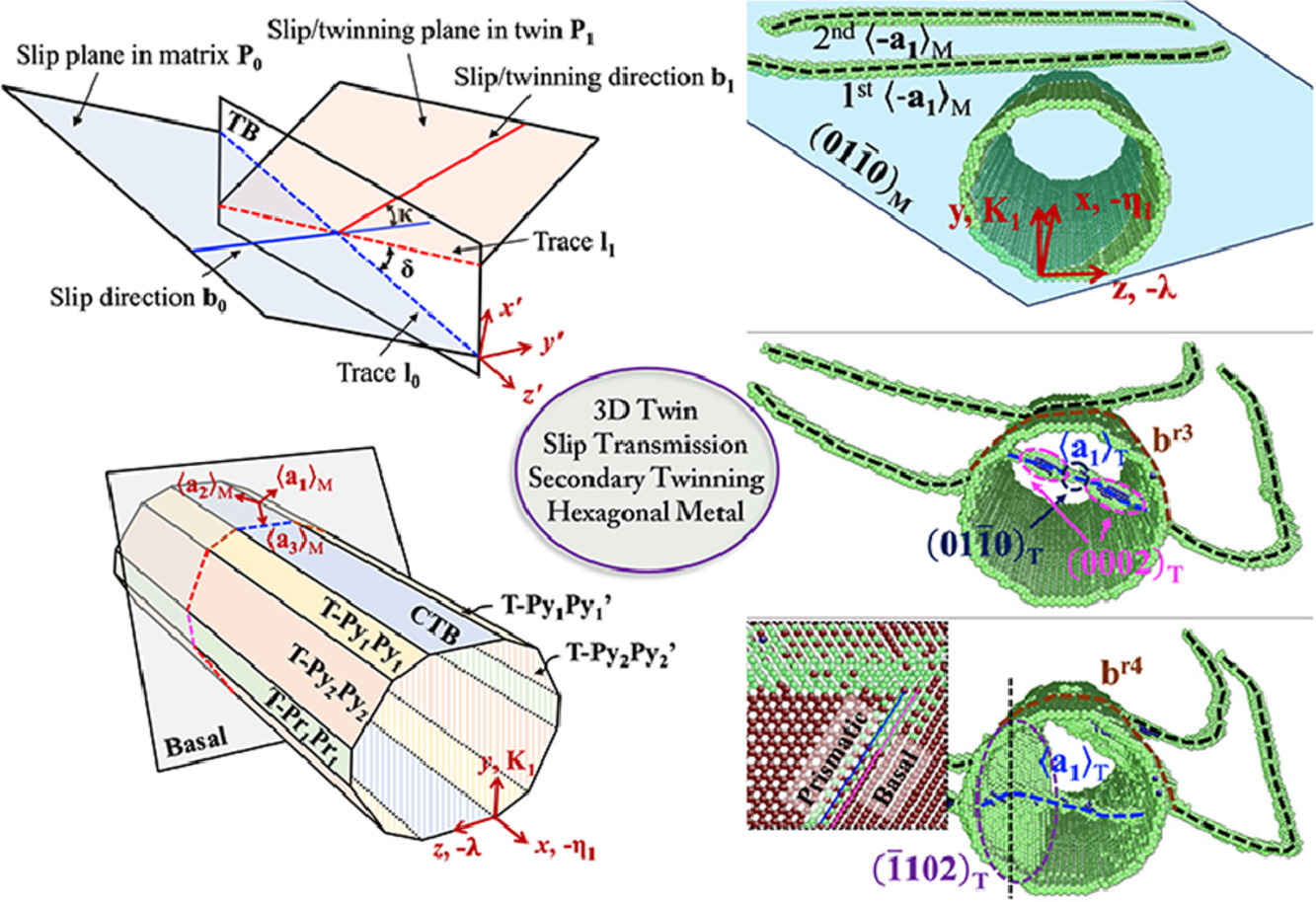
在Ti的形變過程中,經常會出現基底面或柱面上的位錯和{11-22} 壓縮孿晶。在本工作中,我們采用了晶體學分析和原子尺度模擬研究了兩者之間的相互作用。對于三維{11-22}孿晶,我們首先研究了連接基體和孿晶中兩個低指數面的7種可能的孿晶界。之后,我們主要聚焦于兩個低能界面,即{11-22}M/T || {11-22}T/M 共格孿晶界(CTB)和 {-12-11}M/T || {-12-11}T/M。根據位錯的特點和晶界的類型,我們定義了4種位錯和孿晶界的相互作用。進一步地,我們應用晶體學分析,基于形變能力和彈性能變化預測了孿晶界上或穿過孿晶界的可能的位錯反應,例如每種相互作用中一次孿晶、滑移傳導和二次孿晶的形成和消失等。之后我們對選定應力下所有的相互作用進行了分子動力學模擬,以探究各類相互作用的動力學過程并對預測的位錯反應進行檢驗。模擬結果表明,位錯和某些面之間的相互作用可能導致在基面或柱面上形成二次孿晶和位錯,并且模擬揭示了在孿晶中形成
dislocations on basal or prismatic planes and {11-22} compression twins are commonly activated in deformed Titanium (Ti). In the present work, their interactions are investigated by both crystallographic analysis and atomistic simulations. For a three-dimensional {11-22} twin, we firstly analyze seven possible twin boundaries (TBs) bonding two low index planes in matrix and twin. Next, we focus on the two lower energy boundaries,{11-22}M/T || {11-22}T/M coherent twin boundary (CTB) and {-12-11}M/T || {-12-11}T/M . Depending on dislocation character and boundary type, we define four types of interactions between dislocations and these TBs. Further, we predict possible dislocation reactions on/across TBs using crystallographic analysis according to the deformation compatibility and the change in elastic energy, such as twinning/detwinning of the primary twin, slip transmission and secondary twinning, for each type of interaction. Molecular dynamics (MD) simulations are then conducted for all interactions under pre-selected loadings in order to explore the dynamic process associated with each of these interactions and examine the predicted reactions. MD simulations predict that the interaction between dislocations and some facets can lead to the formation of secondary twins and dislocations on basal or prismatic planes in twins, and reveal the possibility of forming
Y. Yang: yonyang@cityu.edu.hk, 香港城市大學
M.X.Pan: panmx@aphy.iphy.ac.cn,中科院物理所;中國科學院大學;松山湖材料實驗室
P.F. Guan: pguan@csrc.ac.cn,北京計算科學研究中心
S. Srinivasan, C. Kale, B.C. Hornbuckle, K.A. Darling, M.R. Chancey, E. Hernández-Rivera,
Y. Chen, T.R. Koenige, Y.Q. Wang, G.B. Thompson, K.N. Solanki?
B. Christiaen, C. Domain, L. Thuinet, A. Ambard, A. Legris?
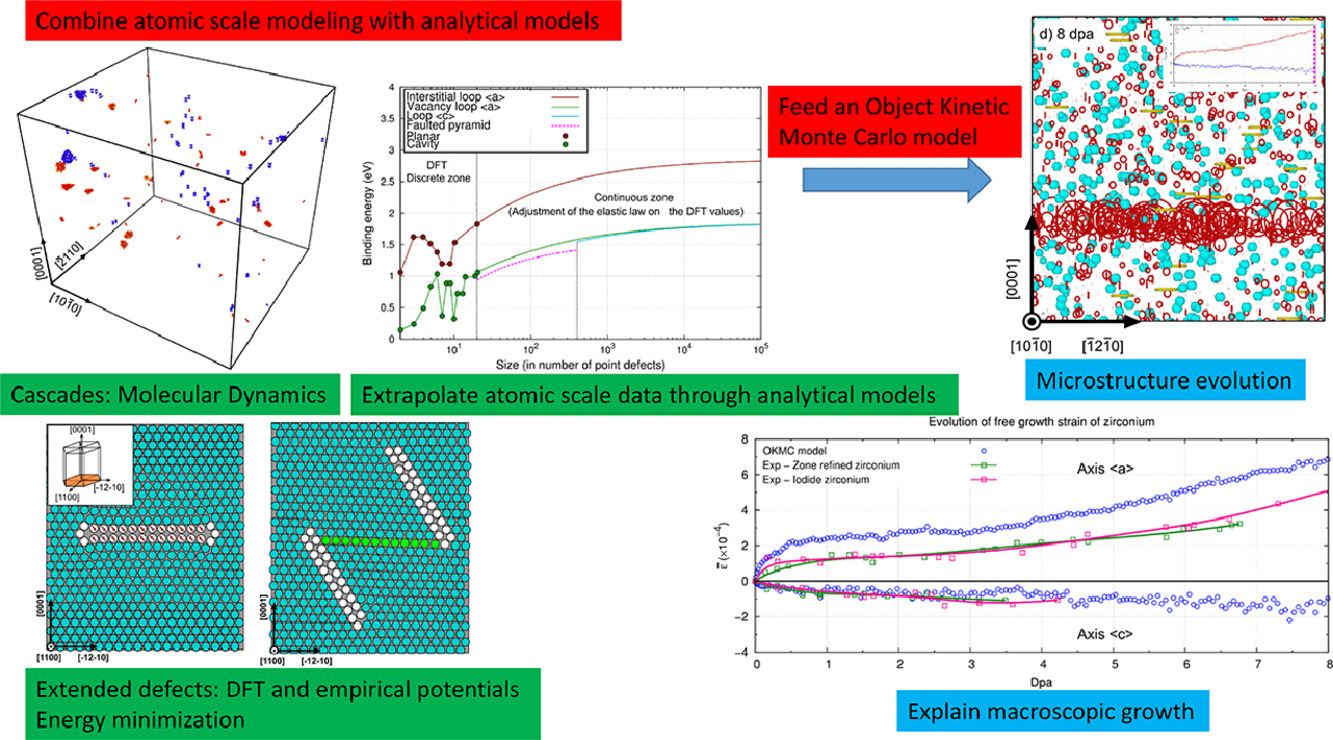
在這項工作中,我們采用了一系列的實體動力學蒙特卡洛模擬,輔以分析模型,試圖合理解釋與高純度再結晶鋯合金在輻照下的生長有關的若干實驗事實。我們對實驗現象的看法主要基于空位擴散各向異性,(即在基面方向的擴散比垂直于基面方向擴散更快),這是導致平行于基面形成 棱柱間隙型位錯環的必要條件。輻照變形的加速與這種局部損傷密切相關。基于空位和間隙原子的各向異性擴散建立的分析模型可以有效解釋實驗現象。
In this work, we propose a series of Object Kinetic Monte Carlo simulations complemented by an analytical model that allows rationalizing a certain number of experimental facts related to the growth of high purity, recrystallized zirconium alloys under irradiation. Our vision of the phenomenon rests essentially on vacancy diffusion anisotropy (with faster diffusion in the basal planes than perpendicular to them) that is necessary to lead to the formation of layers of prismatic interstitial dislocation loops parallel to the basal plane. The acceleration of the deformation under irradiation and this localization of the damage are strongly connected. An analytical model developed using the concepts of difference of anisotropic diffusion between vacancies and interstitials makes it possible to account for the observed phenomena.